


Got a Planning Enforcement Letter? Here’s What to Do
Few things are more unsettling for a homeowner or developer than receiving a planning enforcement letter from the local council. Whether it arrives unexpectedly or follows a neighbour’s complaint, the language of such letters can be formal, intimidating and confusing. But before you panic, take a breath: a planning enforcement letter does not mean all is lost.
In this guide, we’ll explain what a planning enforcement letter is, why you may have received one, and—most importantly—what to do next. Timely, informed action can make all the difference to the outcome.
Don’t complicate your case further by submitting a retrospective application alone…Let us help you!
We have great success rates at securing planning consent for retrospective planning applications!
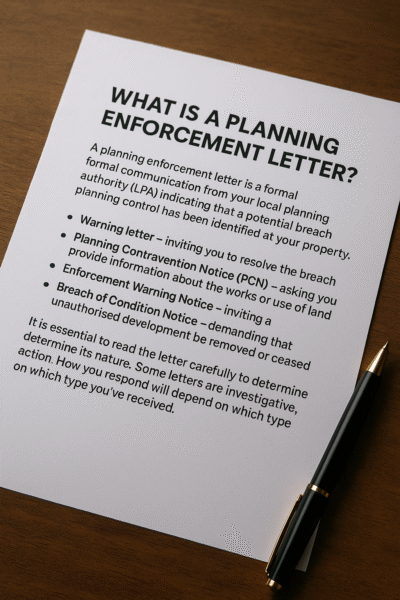
A planning enforcement letter is a formal communication from your Local Planning Authority (LPA) indicating that a potential breach of planning control has been identified at your property. This letter does not itself constitute formal enforcement action but may serve as the starting point for it. Depending on the nature and severity of the alleged breach, the communication may take one of several forms:
-
Warning letter – an informal letter notifying you of a potential breach and inviting you to take remedial steps voluntarily, often before any formal notice is issued.
-
Planning Contravention Notice (PCN) – a formal request for information issued under section 171C of the Town and Country Planning Act 1990, allowing the council to gather details before deciding whether enforcement action is appropriate.
-
Enforcement Warning Notice – introduced under section 172ZA of the 1990 Act, this notice invites a retrospective planning application where the LPA believes the unauthorised development has a reasonable chance of being granted permission.
-
Breach of Condition Notice (BCN) – issued where a condition attached to an existing planning permission has not been complied with. It requires corrective action without the need for a planning appeal route.
-
Enforcement Notice – the most serious of the above, this formal notice sets out what constitutes the breach, what must be done to remedy it, and by when. It may also be accompanied by a Stop Notice or Temporary Stop Notice in urgent cases.
It is essential to read the letter carefully and determine exactly what is being alleged, what type of document it is, and whether it imposes any deadlines. Some letters are investigative, aiming to establish facts before a decision is made, while others begin the process of formal enforcement. How you respond—and when—can significantly affect the outcome.




In many cases, the breach is reported by a neighbour. Alternatively, the issue may have come to light during a routine site visit or when a property is listed for sale or rent.
Local planning authorities have responsibility for taking whatever enforcement action may be necessary, in the public interest, in their administrative areas. However, this does not mean that enforcement action is inevitable—many issues are resolved informally or through a retrospective planning application.
Should I Be Worried?
The short answer is: not necessarily—but you do need to take it seriously. A planning enforcement letter is not a fine or prosecution, but it is a warning that your development or use may not be lawful. Ignoring it can result in more serious consequences, including:
-
A formal Enforcement Notice requiring you to undo the development
-
Legal action in the magistrates’ court for non-compliance
-
Financial penalties or prosecution
Crucially, enforcement is discretionary, not automatic. Councils are encouraged by the National Planning Policy Framework (2024) to act proportionately and to resolve issues through negotiation where possible. If your development could be acceptable in planning terms, the council may invite you to submit a retrospective planning application.
Get help from us today
What Should I Do First?
Here’s what you need to do if you’ve received a planning enforcement letter:
1. Don’t ignore it
Responding promptly shows you are engaging in good faith. Delaying or ignoring correspondence may escalate the matter unnecessarily.
2. Read it thoroughly
Identify what type of notice it is. Does it request information (as in a PCN), or is it asking you to take specific action? Make a note of any deadlines.
3. Understand the alleged breach
Try to establish exactly what part of your development is under scrutiny. This might relate to height, scale, location, use, or breach of planning conditions.
4. Check your permissions and conditions
Review any existing planning consents or certificates for the property. Did you rely on permitted development rights? Were conditions attached to earlier approvals?
5. Seek professional advice by RPE
This is where expert support becomes invaluable. RPE will:
-
Assess whether a breach has occurred
-
Determine if retrospective permission is possible
-
Help you respond to the council
-
Draft and submit any required applications
Will I Need to Remove the Works?
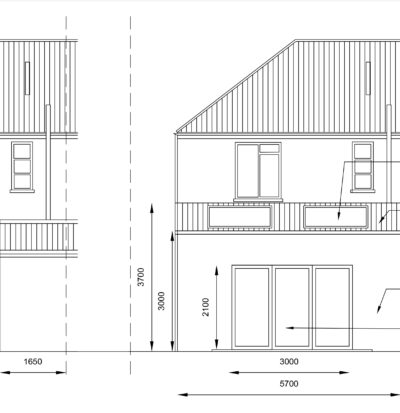
Not necessarily. The outcome depends on whether the development would likely have been approved had it been applied for at the correct time. If your development is generally in line with local planning policy—e.g. it respects neighbours’ privacy, fits within design guidance, and doesn’t harm the area—then the council may be open to retrospective planning approval.
In fact, many enforcement investigations result in no further action once the breach is resolved by regularising the development or complying with conditions.
However, if the development is clearly harmful or unlawful (e.g. significantly overbearing, located on protected land, or unsafe), the council may insist on its removal.
Retrospective Planning Permission: A Way Forward
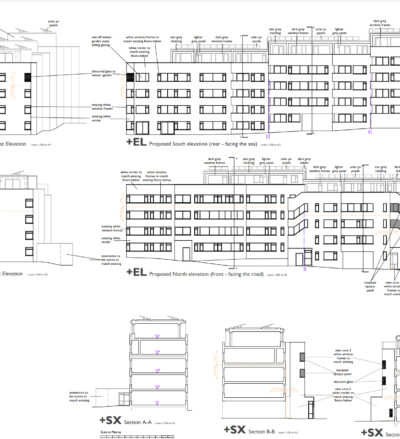
In most cases, submitting a retrospective planning application is the best course of action. This allows you to formally request consent for the existing development, and if granted, it effectively resolves the enforcement issue.
At Retrospective Planning Experts, we specialise in:
-
Fast-tracked assessments of enforcement letters
-
Preparing strong retrospective planning applications
-
Advising on fallback strategies if an application is refused
-
Managing appeal processes where required
Time is of the essence in these cases—deadlines on enforcement letters can be strict, and missing them may lead to escalation.

What If My Application Is Refused?
If your retrospective application is refused, you have two main options:
-
Appeal the decision to the Planning Inspectorate
-
Remove or alter the works as directed by the council
Whether you choose to appeal or comply will depend on the planning merits, potential legal exposure, and broader impact on your property. We can help you weigh these options and present the strongest case possible if you pursue an appeal.
